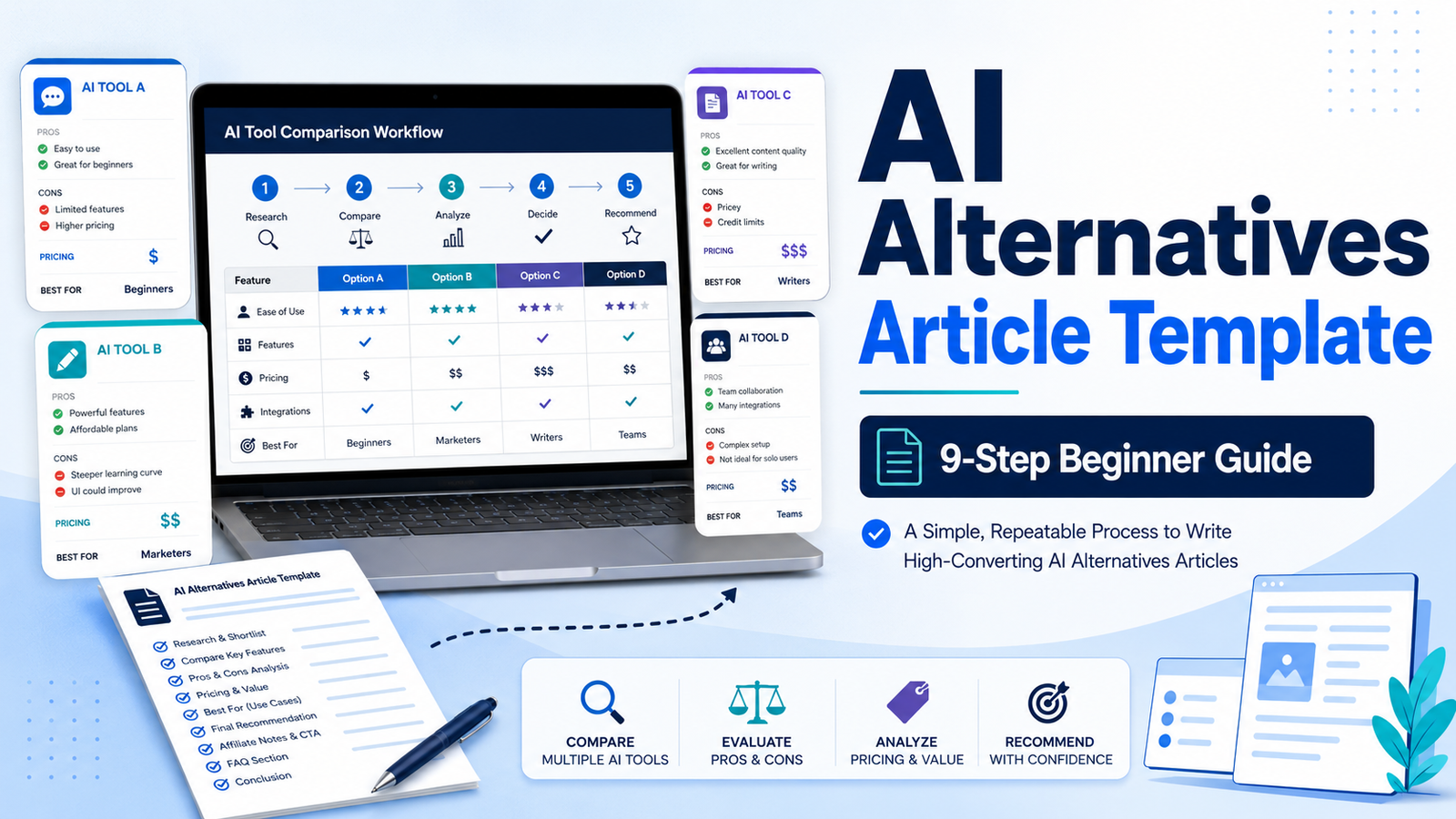
This AI alternatives article template helps beginner AI affiliate bloggers structure alternatives posts with comparison tables, pros and cons, pricing notes, affiliate CTAs, internal links, and a clear next step for the reader.
Most beginner alternatives posts fail because they only list random tools. A stronger alternatives article explains why someone may want a replacement, who the original tool is best for, which alternatives make sense, how the options compare, and what the reader should do next.
I am building an AI affiliate blog from zero and documenting the process. This site is not just an AI tool review site. It is a beginner AI affiliate blogging lab that helps beginners write structured AI tool reviews, pricing guides, alternatives posts, and comparison articles.
The goal of this guide is simple: help you write better AI alternatives posts without starting from a blank page.
Quick Answer: A good AI alternatives article template should explain the original tool, why readers may want an alternative, the best replacement options, key differences, pros and cons, pricing considerations, affiliate CTA placement, internal links, and a final recommendation.
What Is an AI Alternatives Article Template?
An AI alternatives article template is a repeatable structure for writing posts like “Best Jasper AI Alternatives,” “Copy AI Alternatives,” or “Writesonic Alternatives.”
Instead of randomly listing tools, the template helps you build a useful article that answers the reader’s real question:
“If this tool is not right for me, what should I use instead?”
A strong AI alternatives article template helps you decide:
- How to introduce the original tool
- How to explain why readers may want alternatives
- How to choose replacement tools
- How to build a comparison table
- How to explain each alternative clearly
- How to include pros and cons
- How to discuss pricing and value
- Where to place affiliate CTAs
- Where to add internal links
- How to end with a clear recommendation
This matters because alternatives keywords often attract readers who are already comparing tools. They may already know the original tool, but they are not sure whether it is the best fit.
Why Alternatives Posts Matter for AI Affiliate Blogs
Alternatives posts are valuable for AI affiliate blogs because they sit close to buyer decision intent.
Someone searching for an alternative usually has a specific reason:
- The original tool is too expensive
- The free plan is too limited
- The tool is too complicated
- The tool does not fit their workflow
- They want a cheaper option
- They want a better tool for blogging, SEO, marketing, or automation
This makes alternatives posts useful for both readers and affiliate content strategy.
For example, if someone reads a Jasper AI Alternatives article, they may be comparing Jasper with tools like Copy AI, Writesonic, ChatGPT, or other AI writing platforms.
If your article helps them understand which tool fits their use case, the content becomes more helpful and more likely to support affiliate clicks later.
How Alternatives Posts Are Different From Reviews and Pricing Guides
An alternatives post is not the same as a review, pricing guide, or comparison post.
Each content type has a different job inside an AI affiliate blog.
| Content Type | Main Search Intent | Main Goal |
|---|---|---|
| AI Tool Review | Is this tool good? | Explain whether one tool is worth using overall |
| AI Pricing Guide | How much does this tool cost? | Explain plans, value, and best-fit users |
| AI Alternatives Article | What should I use instead? | Compare multiple replacement options |
| AI Comparison Post | Which of these two tools is better? | Compare two tools directly |
If you want the full review structure, read the AI Tool Review Template.
If you want to structure pricing posts, read the AI Pricing Guide Template.
AI Alternatives Article Template at a Glance
This AI alternatives article template is designed to make alternatives posts easier to write, easier to scan, and easier to connect with the rest of your AI affiliate blog content system.
| Section | Purpose | What to Include |
|---|---|---|
| Introduction | Set the search intent | Original tool, reader problem, promise of alternatives |
| Quick Answer | Help readers fast | Best overall alternative, best budget option, best beginner option |
| Original Tool Context | Explain what is being replaced | Who the original tool is for and why people use it |
| Why Look for Alternatives? | Match reader motivation | Price, features, complexity, limits, workflow fit |
| Comparison Table | Make the article scannable | Tool name, best for, pricing note, strengths, beginner fit |
| Alternative Breakdown | Explain each option | What it does, who it fits, pros, cons, CTA |
| Final Recommendation | Guide the decision | Best overall, best beginner choice, best budget choice |
Step 1 — Start With the Original Tool
Every alternatives article should start with the original tool.
The reader already has that tool in mind. They may be searching because they are not fully satisfied with it, but they still need context.
Start by explaining:
- What the original tool does
- Who normally uses it
- Why it became popular
- What it is good at
- Why some people may still want a different option
Keep this section balanced. Do not attack the original tool just to promote alternatives.
Example:
[Original Tool] is a popular AI writing tool for users who want help with blog posts, marketing copy, and content workflows. However, it may not be the best fit for every beginner because some users may want a cheaper, simpler, or more SEO-focused alternative.
Step 2 — Explain Why Readers Want Alternatives
This is one of the most important parts of an alternatives article.
If you skip this section, the article can feel like a random list.
Readers may want alternatives because of:
- Price
- Feature limits
- Complex setup
- Weak SEO features
- Limited free plan
- Too many team-focused features
- Not enough beginner-friendly structure
Your job is to explain those reasons clearly before listing replacement tools.
For beginner AI affiliate bloggers, this section is also useful because it helps you match alternatives to real reader problems.
Step 3 — Choose the Best Alternative Options
Do not include every tool you can find.
A strong alternatives article usually works better when it focuses on the most relevant options.
You can organize alternatives by use case:
- Best overall alternative
- Best budget alternative
- Best beginner-friendly alternative
- Best for bloggers
- Best for marketers
- Best for teams
- Best free or low-cost option
This makes the article easier to scan and more useful than a long, unorganized list.
Step 4 — Create a Comparison Table
A comparison table is one of the most useful parts of an alternatives article.
Readers often want to compare options quickly before reading detailed explanations.
Here is a simple structure you can use:
| Alternative | Best For | Pricing Note | Beginner Fit |
|---|---|---|---|
| Alternative 1 | Best overall replacement | Free or paid plans available | Good for beginners |
| Alternative 2 | Best budget option | Lower-cost plan | Good if you want to save money |
| Alternative 3 | Best for SEO content | May cost more | Useful for bloggers |
You can see this type of structure in action in my Jasper AI Alternatives guide.
Step 5 — Explain Each Alternative Clearly
After the comparison table, explain each alternative one by one.
Use the same structure for each tool so the article feels organized.
A simple breakdown can include:
- What the alternative does
- Who it is best for
- Why it may be better than the original tool
- Where it may be weaker
- Pricing note
- Best use case
Alternative Tool Format:
Best for: [Beginner bloggers / marketers / teams / budget users]
Why it is a good alternative: [Explain the main reason]
Possible downside: [Explain one honest limitation]
Best next step: [Try free plan, compare pricing, read review, or check alternatives]
This helps readers compare options without feeling lost.
Step 6 — Add Pros and Cons
Pros and cons make alternatives posts more trustworthy.
Do not write only positive points. If every tool sounds perfect, the article feels less useful.
| Pros | Cons |
|---|---|
| May be easier for beginners | May have fewer advanced features |
| Could be cheaper than the original tool | Cheaper plans may have limits |
| May fit a specific use case better | May not be the best all-in-one option |
This is especially important in affiliate content because readers need to feel that the recommendation is balanced.
Step 7 — Discuss Pricing and Value
Alternatives posts should include pricing considerations because many readers search for alternatives when the original tool feels too expensive.
You do not always need to list every plan in detail, but you should explain the pricing angle.
Useful questions to answer:
- Is the alternative cheaper than the original tool?
- Does it offer a free plan or free trial?
- Is the paid plan beginner-friendly?
- Does the pricing fit bloggers, marketers, or teams?
- Is the value better for the reader’s use case?
For pricing-focused examples, you can read:
If you want to write pricing posts yourself, use the AI Pricing Guide Template.
Step 8 — Add Affiliate CTAs Naturally
Affiliate CTAs can work well in alternatives posts because readers are already comparing options.
But the CTA should not feel forced.
A weak CTA sounds like this:
Buy this tool now because it is the best.
A stronger CTA sounds like this:
Best for beginners who want a simpler option: If the original tool feels too expensive or complex, start by comparing the free plan or entry-level plan of this alternative before upgrading.
The stronger CTA helps the reader make a decision instead of pushing a sale.
Step 9 — Add Internal Links and Next Steps
Internal links are important because an alternatives article should not sit alone.
It should connect to the rest of your AI affiliate blog system.
An alternatives post can link to:
- A full tool review
- A pricing guide
- A comparison post
- A best tools list
- A blog post template
- A checklist or lead magnet
For example, an AI alternatives article can connect to:
- AI Tool Review Template
- AI Pricing Guide Template
- Jasper AI Alternatives
- How I’m Building an AI Affiliate Blog From Zero
This turns one article into part of a larger beginner AI affiliate blogging system.
Free AI Blog SEO Checklist
If you are writing AI alternatives posts, do not only focus on the list of tools.
Your post also needs a clear keyword, search intent, comparison structure, useful internal links, affiliate CTA placement, lead magnet CTA placement, and a next step for the reader.
Free AI Blog SEO Checklist
Before publishing your next AI tool review, pricing guide, alternatives post, or comparison article, use this free checklist to review the weak parts beginners often miss.
Want the Full AI Blog Starter Kit?
The Free AI Blog SEO Checklist helps you check your post before publishing.
The AI Blog Starter Kit helps you actually write and structure the post from the beginning.
It includes beginner-friendly templates for:
- AI tool reviews
- AI pricing guides
- AI alternatives articles
- AI comparison posts
- Affiliate CTA sections
- Internal linking
- Lead magnet CTA placement
- Beginner-friendly blog post structure
Want the templates instead of starting from a blank page?
The AI Blog Starter Kit gives you simple templates for writing AI tool reviews, pricing guides, alternatives posts, and comparison articles from the beginning.
Related AI Blogging Guides
- Free AI Blog SEO Checklist
- AI Tool Review Template
- AI Pricing Guide Template
- How I’m Building an AI Affiliate Blog From Zero
- Jasper AI Alternatives
- Copy AI Pricing
- Writesonic Pricing
This AI alternatives article template is also useful because it keeps every alternatives post consistent across your AI affiliate blog.
You can reuse this AI alternatives article template whenever you write about AI writing tools, SEO tools, automation tools, or other software categories.
The main benefit of using an AI alternatives article template is that you do not have to create a new structure from scratch every time.
Instead, the AI alternatives article template gives you a simple repeatable framework for explaining replacement options, pricing differences, pros and cons, and next steps.
This AI alternatives article template is also useful because it keeps every alternatives post consistent across your AI affiliate blog.
You can reuse this AI alternatives article template whenever you write about AI writing tools, SEO tools, automation tools, or other software categories.
The main benefit of using an AI alternatives article template is that you do not have to create a new structure from scratch every time.
Instead, the AI alternatives article template gives you a simple repeatable framework for explaining replacement options, pricing differences, pros and cons, and next steps.
For beginner bloggers, this AI alternatives article template can become part of a larger content system with reviews, pricing guides, comparison posts, and affiliate CTAs.
Final Verdict
If you are a beginner AI affiliate blogger, use an AI alternatives article template before writing alternatives posts. Do not only list random tools.
A strong alternatives article should explain the original tool, why readers may want a replacement, which alternatives are best, how the options compare, what each tool is good for, and what the reader should do next.
Alternatives posts can become useful content assets because they help readers compare options before making a decision. But the article needs structure, not just a list.
This AI alternatives article template gives you a repeatable starting point for writing clearer, more useful alternatives posts for your AI affiliate blog.
→ Download the Free AI Blog SEO Checklist